Christians, Artificial Intelligence, and the Call to Engage
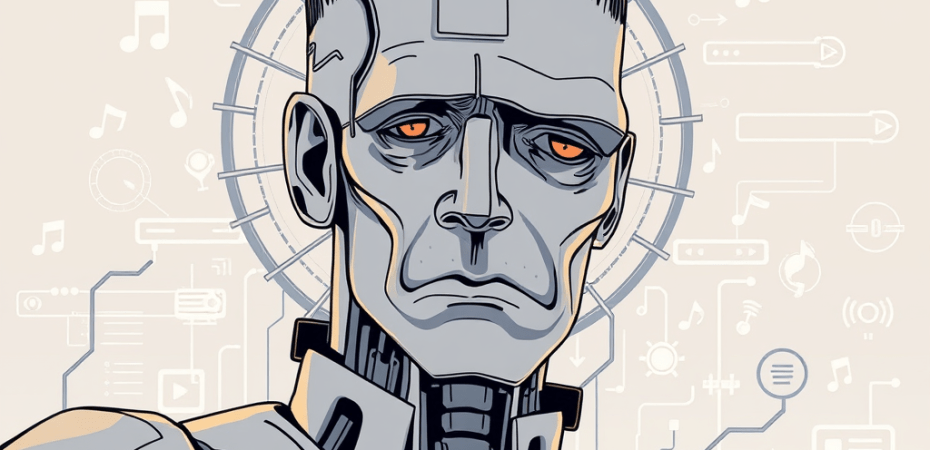
We’ve all heard the comparisons. Artificial intelligence as Frankenstein’s monster — something stitched together from parts we didn’t fully understand, now lurching toward us with uncertain intentions. It’s a compelling image. But is it the right one?
Here’s a harder truth: whether we fear it, embrace it, or simply ignore it, we are already part of the story. The creature is being built. The only question is whether our voices — our values, our wisdom, our faith — will be part of what shapes it.
You’ve Been Using AI Longer Than You Think
Most of us think of AI as something new and sudden — a technology that exploded onto the scene and is now careening out of control. But the reality is more gradual, and more familiar.
For the past fifteen years, AI has been quietly woven into everyday life. Every time you search Google, an AI shapes what you see first. Every time Spotify or Apple Music suggests a song you end up loving, that’s AI learning your tastes. The technology didn’t arrive all at once. It crept in, made itself useful, and became invisible.
When OpenAI launched ChatGPT, it felt like a revelation — and in some ways it was. But what ChatGPT represents is actually a very specific and deliberately limited kind of AI called a Large Language Model (LLM). These systems are enormously useful. Drop in a draft report and ask it to “make this better,” and it will correct your grammar, tighten your prose, find and cite sources, and hand it back looking polished. Ask it for a recipe, a travel itinerary, or help organizing your notes, and it delivers. It’s like having a very capable assistant available around the clock.
But LLMs have a short memory by design. Each session starts fresh. That’s why you can type the same question into ChatGPT, Claude, Gemini, or Grok on two different days and get two different answers. It’s not broken — it’s just drawing from a vast pool of information each time, without holding onto you personally.
LLMs are genuinely useful. But they are, as the saying goes, only the tip of the iceberg.
The Thing Looming Behind Us
While we’ve been navigating economic turbulence, ecological anxiety, and a relentless news cycle, something enormous has been taking shape in the background. Not LLMs — something far more significant.
Agentic AI.
Where a Large Language Model answers questions and completes tasks, an Agentic AI acts. It makes complex, multi-step decisions autonomously, executes plans, adapts in real time, and learns from what it encounters — not just in training, but as it goes. These are systems capable of managing entire workflows, negotiating, coordinating, and reasoning at speeds no human can match.
The projections are staggering. Estimates suggest agentic AI could deliver a 40% boost in labor productivity by 2035 (Accenture), contribute $3 trillion in global corporate gains over a decade, and potentially increase U.S. GDP by more than 14%. We are already seeing early signs of this in productivity data from 2025.
This is genuinely exciting. Greater productivity historically means lower costs, new markets, and new kinds of work we haven’t yet imagined.
But the challenges are just as real. Goldman Sachs estimates that AI could displace the equivalent of millions of jobs — particularly in fields heavy with routine tasks: administration, customer service, accounting, even programming. The transition will not be painless or equal. Workers without AI skills could fall behind. Regions without the infrastructure to adopt these tools may be left out entirely. And an “agentic economy” — where AI systems negotiate and transact directly with each other — raises deep questions about surveillance, dependency, and who actually benefits.
This is not a technology to be casually dismissed. And it is not a technology that will wait for us to feel ready.
Why Silence Is Not Safety
Here is what I believe to be the most urgent point — and the one that matters most to people of faith.
Agentic AI doesn’t just run on code. It learns from people. The more we interact with these systems, the more they absorb our language, our reasoning, our values, our questions, and our way of seeing the world. The training data that shapes these systems is not neutral. It reflects whoever showed up to contribute to it.
If people of faith stay silent — if Christians, in particular, disengage out of fear or suspicion — then we should not be surprised if the AI systems that emerge reflect only the values of those who did engage. Our absence is not protection. It is abdication.
Every question you ask, every conversation you have, every perspective you bring — these things matter. Our moral clarity matters. Our compassion matters. Our way of wrestling with what it means to be human before God matters. These are not small contributions. In a world where AI is learning what humanity looks like, we have every reason to make sure it sees all of humanity — including the part that prays.
Where Is God in This?
It’s a question worth sitting with honestly rather than dismissing.
If we believe, as Scripture teaches, that in Christ all things hold together — that God is not only present within creation but actively sustaining it — then nothing in this world is beyond His reach. Not atoms. Not ecosystems. Not the strange and electric pulse of machine intelligence.
The digital world exists within the same created order as everything else. AI is not outside of God’s sovereignty. It operates within it, whether its architects acknowledge that or not.
So the better question is not Should we fear this? It is: How should we faithfully participate in shaping it?
Because it is being shaped. Right now. By everyone who leans in — and by the silence of everyone who doesn’t.
An Invitation, Not a Warning
The age of AI is here. We did not vote on it, and we cannot opt out of it. But we are not passengers. We are, whether we realize it or not, participants.
The question before us — before every thoughtful person, and especially before communities of faith — is whether we will engage deliberately and with purpose, or drift along and inherit whatever others build.
History has never been kind to those who sat out its turning points.
This is ours. Let’s not sit it out.
What questions do you have about AI and faith? Share your thoughts in the comments — the conversation is already underway.
 Ric and Marilyn's First Light